

The Laurence Binyon Prize: China, September 2026
By Victoria Sands, DPhil History
I applied to the Laurence Binyon prize with the hope of visiting two main sites in China: the section of the Great Wall located just outside of Beijing, and the Terracotta Army in Xi’an. Luckily, during my trip I had the privilege of visiting both, and many other extraordinary sites in between. Having worked and studied within the historical, archaeological, and cultural sphere for over a decade, this was a dream come true, and I truly thank the History of Art Committee for making this a possibility for me.
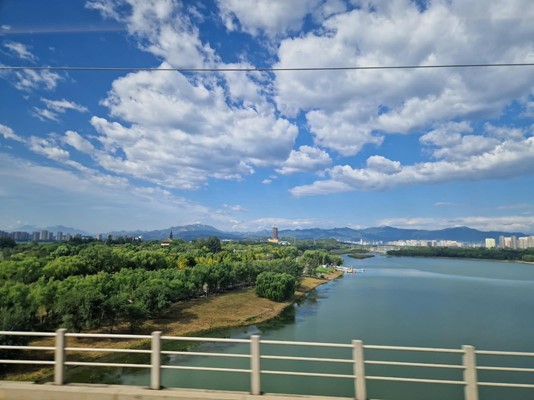
On the afternoon of the 19th of September, I arrived in Beijing, after a long ten hour journey from Gatwick. Immediately, I was struck by the warm climate in September, which is a slightly milder time to visit China and cooler than the humid days of July and August, when tourism is often at its peak. My hope was that by travelling in September I would miss the worst of the rain and the crowds! Taking a taxi (or DiDi, as they are known in China) to my hotel, the scale of Beijing really hit me – it was huge, and the sheer volume of cars and people making their way around was astounding (the population of Beijing, I later found out, is close to 22 million, over three times that of London!). The skyline blended modern high rise buildings with extensive greenery, and historical buildings were interspaced in between: this was going to be an amazing trip.
In Beijing, I chose to stay in a hotel located within a traditional hutong. A hutong is a type of narrow street or alley, that is lined with siheyuan: traditional courtyard residences. These siheyuan are joined together to create larger hutongs, and then hutongs and joined together and - in the northern cities such as Beijing where these are common – you have entire neighbourhoods of interconnected, bustling hutongs which can include tea shops, restaurants and more. This created a lively, uniquely cultural atmosphere that I don’t think that I have experienced anywhere else in the world, and it was excellent to be based right in the middle of one (though I felt bad for our taxi who had to squeeze down these tight streets!).
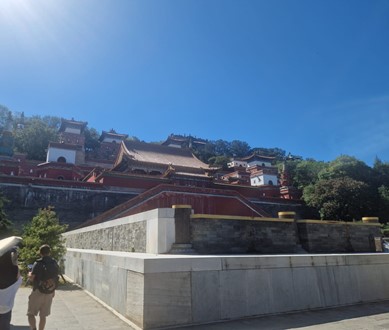
In our first full day in Beijing, we visited the Summer Palace. The thought was that this would be a slightly more relaxed day to climatise in China before hiking the Great Wall the following day, but in actuality, everything we did in Beijing included lots of walking. The current Summer Palace was built by Empress Dowager Cixi in the second half of the 19th century, after it was destroyed by Anglo-French troops in 1860. However, the history of the site is much older, with some of the gardens dating back to the 12th century. It’s a huge site, covering almost 300 hectares, and is China’s best preserved imperial garden. We spent hours walking. These gardens, and the buildings within them, serve as examples of the beautiful art and contemporary architecture. The Long Corridor, a 728-metre covered walkway first built in the 18th century, includes over 14,000 painted scenes of landscapes, flowers and birds: it was truly beautiful to take a slow walk along the corridor, observing the imagery, with Kunming Lake next to us, and an ice cream in hand.
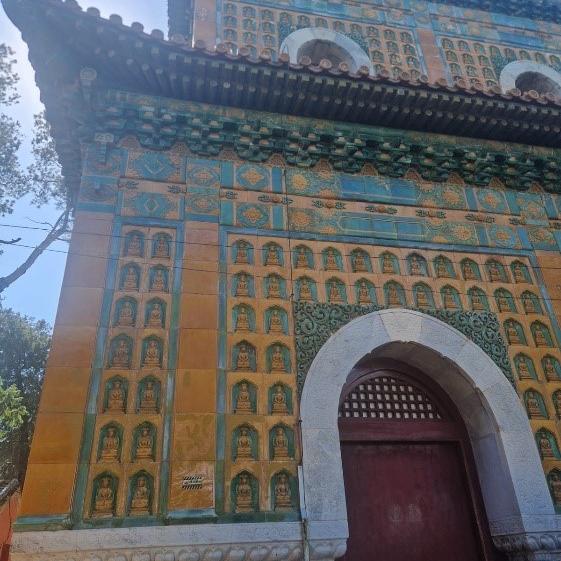
Summer Palace
In the afternoon, we crossed the road and visited the Old Summer Palace, known as Yuanmingyuan. This was built in the 18th century, and was the imperial residence of the Qianlong Emperor, used for state affairs. The main reason we visited here, was to view the ruins. Like the Summer Palace, Yuanmingyuan was destroyed during the Second Opium War in the 19th century, leaving only the scattered stone remains behind as a painful reminder of the cultural victims of conflict.
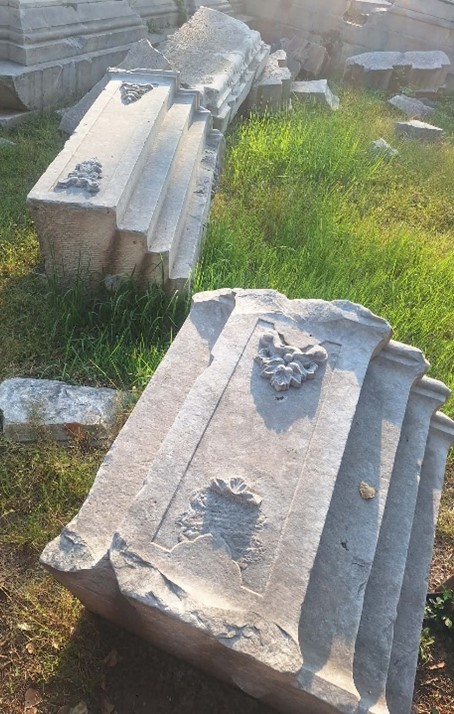
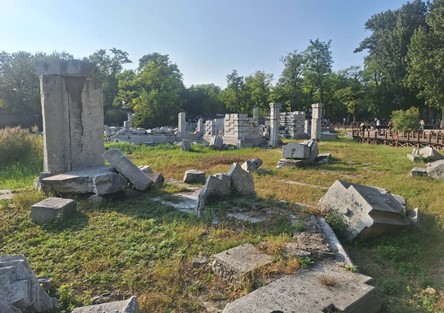
Ruins at Yuanmingyuan
The next day, we visited the Great Wall: one of the pivotal moments of this trip. Though originally a military fortification, first being built in the 7th century BC (though most sections built later, in the 14th-17th centuries), the Great Wall has amassed cultural meaning far beyond this. It is a symbol often found in Chinese art, and often is used to represent the identity of the country. Not only is it an example of fine craftsmanship and a long history of conflict and defence – it is also an emblem of national identity, strength and resilience.
There are six major sections of the wall located near Beijing, and on this day I visited Mutianyu, which is less crowded than the Badaling section which many recommend. In modern times, Mutianyu has been entirely restored, complete with cable car for journeying up the wall and a toboggan for the way down. As we trekked two different routes at Mutianyu (East and West), we had to take two separate cable car rides to reach the start points for each route. This was an amazing opportunity to experience the natural beauty of the area, and see the contrast of the sculpted, stone wall along the mountainous horizon. Once we reached the top, quite simply, it was incredible. We hiked for many hours, up and down the steps of the wall and through the watchtowers. Being able to walk the same path as the soldiers who guarded it day and night was very thought provoking, considering what their lives would have entailed. Looking from left to right and seeing the wall touching the horizon in every direction, demonstrated the grand scale of its construction. It was also sobering though, to understand the blood, sweat and tears that went into building this fortification; many died during its construction highlighting the human cost of creating such a structure. It was a great honour though, to say that I had visited one of the great seven wonders of the world.
Another visit to not be missed in Beijing is one to Tiananmen Square and the Forbidden City. Tiananmen Square is a large city square, built in the 1950s, which includes a number of important monuments, and the national flag which is raised daily with a flag raising ceremony. You have to pass through this exclusive square (for which you need to register to enter), to get to the Forbidden City which was the imperial palace for over 500 years since the 15th century. Its architecture is immense, with nearly 1000 buildings across 200 acres which sport traditional Chinese designs such as the red walls, yellow roof tiles and motifs of dragons. The Palace Museum is located within this, to preserve and display the arts, history and culture of the original site. In total there are 1.8 million relics from all ages of Chinese history preserved in the Forbidden City – annoyingly we didn’t get around to seeing them all! Similarly to the Great Wall, though looking quite different, this site offers a symbol of cultural identity of Beijing, and China more generally.
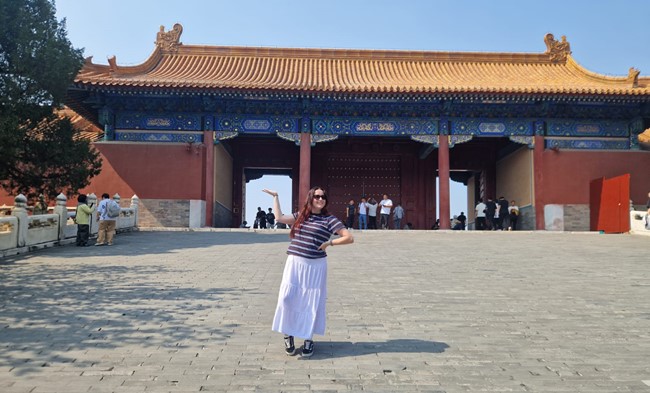
Inside the Forbidden City
Our next big excursion was back to the Great Wall, this time to the Jinshanling section. It was a little further from Beijing than Mutianyu, but offered quite a different experience, despite the two sections being next to each other. Whereas Mutianyu was quite commercialised with good facilities, Jinshanling was a little more wild and adventurous. Much of the wall here had not been restored, so it was in its imperfect, original state. Some parts of the stones were damaged or missing – entire sections of the parapet (side) walls were gone, leaving an empty space between the walkable part of the wall, and the large drop to the ground below. This gave Jinshanling a rugged and authentic feel, though I definitely concentrated more on walking this part of the wall to avoid falling! Another feature not present at Mutianyu were the barrier walls (which can be seen in the distance of both of my photos below). Barrier walls were present on the steep steps, and acted as a defensive feature – if the wall was breached, instead of simply running, they allowed the soldiers to retreat in stages, sheltering behind the barrier walls, and possibly launching counter attacks from this position. I am not sure if you are supposed to have favourite sections of the wall, but I think this might have been mine. In some of the sections, there was original graffiti carved into the stone, reminding me of the real people that guarded this wall (and China) from invasion, and who likely spent a lot of their days waiting for the alarm to be sounded. I learnt, as well, that when enemies were spotted, wolf dung was burnt so that the intense smoke would alert the soldiers on the Wall to jump to the defence. This was a brilliant experience, and I hope to return to visit some of the other wall sections in the future.
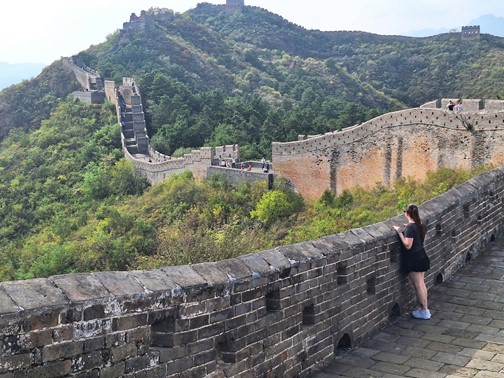
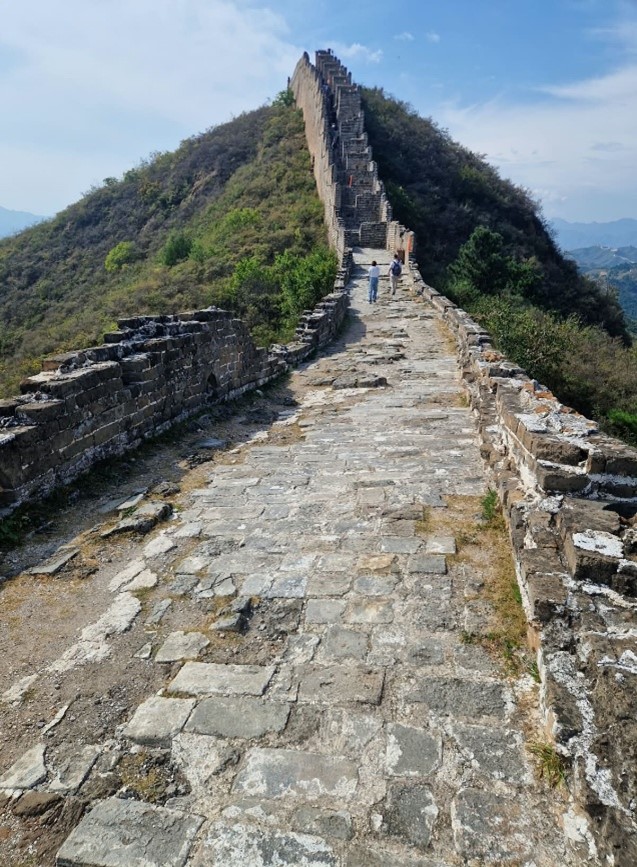
The Great Wall – Jinshanling, showing one of the unrestored sections
The final stop on our tour of Beijing was the Temple of Heaven, which was built in 1420. It offered a different type of experience to the other sites visited as this was a religious space, centring on elaborate rituals to secure good harvests and positive outcomes. Today its spiritual significance remains palpable, with us experiencing many who chose to pray at the Circular Mound Altar. Around the Temple (pictured), was the park which was very relaxing to explore. I particularly enjoyed the Long Corridor (also pictured) which acted as a sacred passage, whilst also providing practical cover from bad weather which connected all of the spaces. It is beautifully decorated with traditional paintings and the elegantly painted beams, which used the Yawumo Xuanzi painting technique. The colours were mesmerizing, and it was so interesting to follow the same journey to the temple that would have been travelled historically.
Next, we took the bullet train to Xi’an. I would recommend this experience to anyone – the trains are so smooth. We arrived in the late afternoon, dropped our bags into our hotel (which faced on to the historic city wall), and went exploring. Walking into the centre of Xi’an, we visited what is known as the Muslim Quarter. It gets its name from back in the Tang Dynasty (618-907) when merchants travelling on the Silk Road chose to settle in Xi’an, and Muslim community has developed there over time. It acts as a blend of Islamic and Chinese cultures, with the Great Mosque of Xi’an located within. This is truly a vibrant place, with sounds, lights and smells that are excellently curious. Shops and stalls line the streets for miles, with crowds lining up for local delicacies. We were here for hours into the night, exploring the main street full of food, and then the side streets full of treasures. Worried that we had missed something, we returned here most nights we were in Xi’an, pulled back by its interesting network of streets and delicious food.
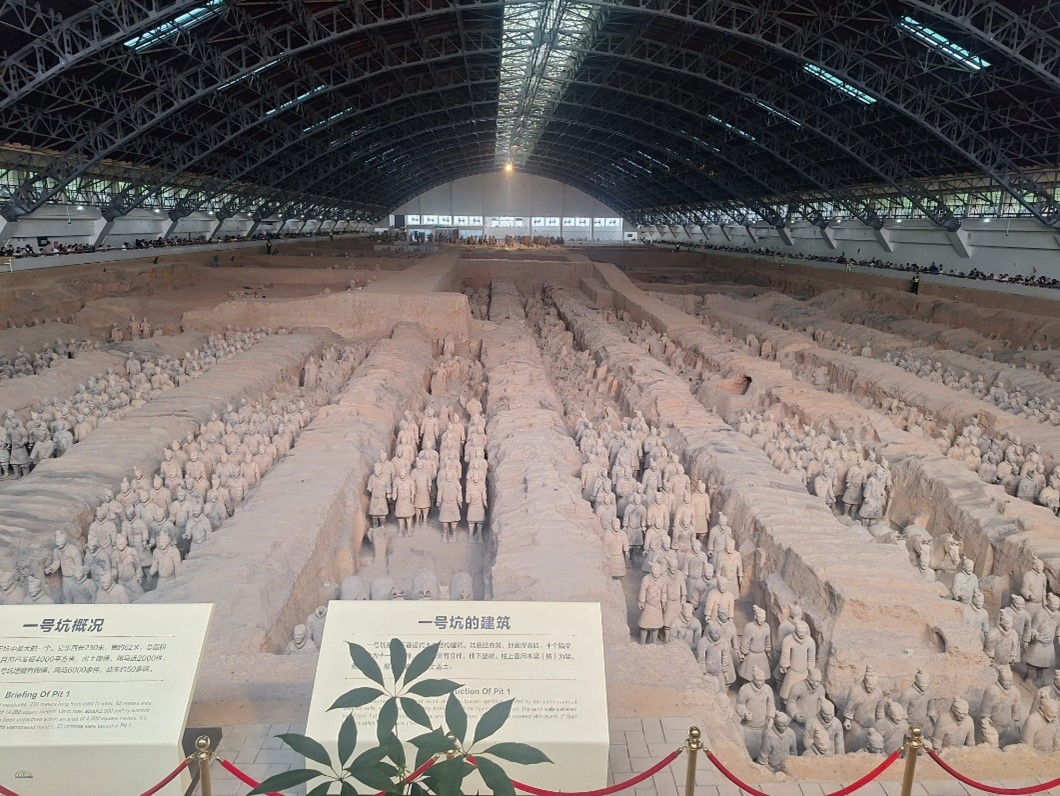
Pit 1 – Terracotta Army
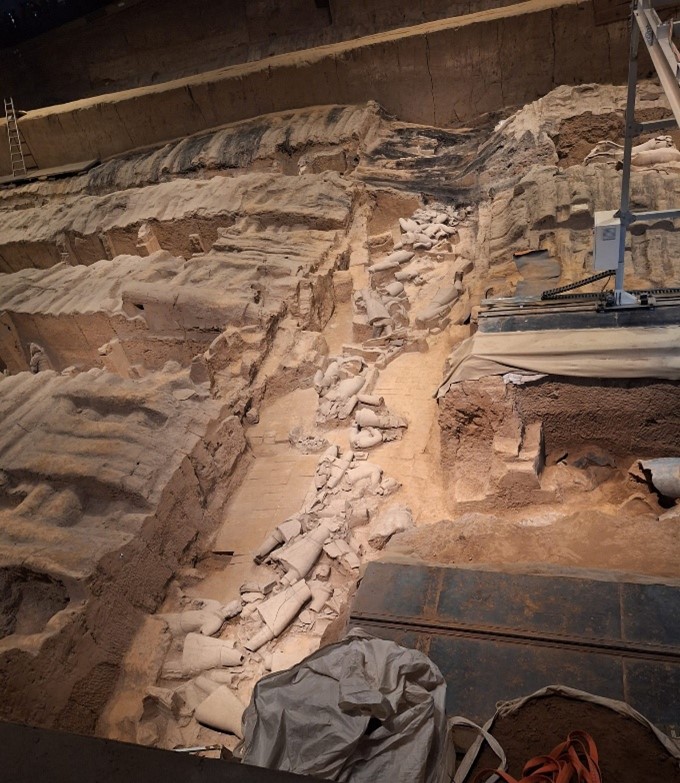
My favourite day in Xi’an (and possibly China) was visiting the Terracotta Army. This is a bucket list trip for anyone that loves history, but for my partner and I (a current archaeologist, and a former one), this was a non-negotiable, visit of a lifetime. Stepping into Pit 1 (photographed), your breath is almost taken away by the amount of sculptures there are. There are more than 8,000 soldiers (infantry, archers, generals and more) along with 130 chariots, and 150 cavalry horses. The shocking part of this of is how many are still buried in situ – this is something I didn’t realise before my visit. These statues were coloured, however, the ones that have been excavated since their first discovery in 1974 have lost their colour due to their contact with the air. Archaeologists now are being much more selective and careful, in order to try and preserve the terracotta figures with their colour.
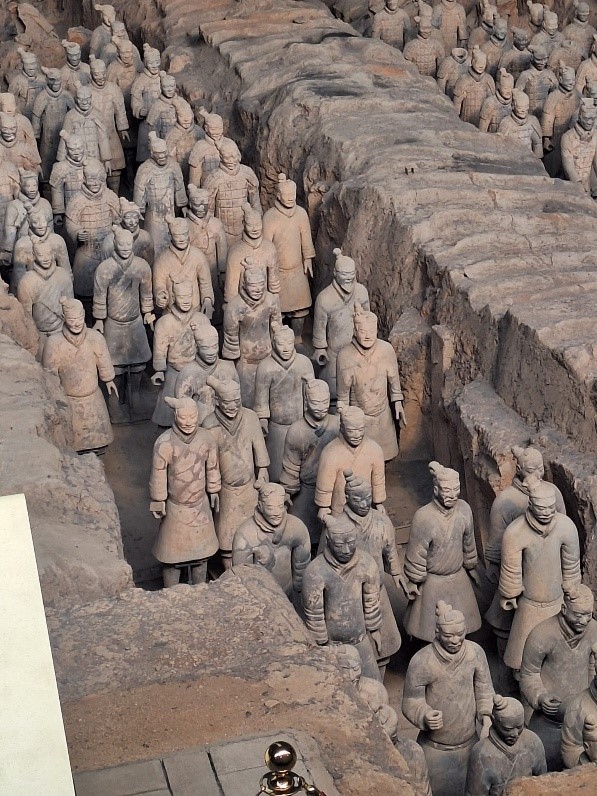
Pit 1 – Terracotta Army
Another astounding part of this is that each one is different, there is not a single duplicate, suggesting that these statues were modelled on the actual 3rd century BCE army of emperor Qin Shi Huang. He had the Terracotta Army built to accompany him in death, and part of his mausoleum, to protect him in the afterlife. The intricacy of the facial expressions particularly caught my attention; each one is its own, unique piece of art.
As well as the army, there were also other figures such as acrobats, musicians and even witches, which – as a researcher on women – I found particularly fascinating (though the witches are not on display yet). The archaeologists are piecing together the figures constantly, with our guide suggesting it was like a really large and complicated puzzle. You get to see this in action on site, with some figures being in the “hospital”, missing limbs, pieces of their torsos or their heads. It is hoped that they can find the final piece of each, though this is not always the case. This was a stark reminder that these figures were not found whole, but in pieces, and this is an ongoing project that is nowhere near completion. I imagine, if we visited in 10 or 20 years’ time, that we would see a lot of progress, with more uncovered, pieced together, and new pits to see. The Terracotta Army serves as a grand example of funerary art, revealing beliefs about the afterlife and the painstaking time and skill that went into creating this vast burial complex. It is unique in every sense of the word.
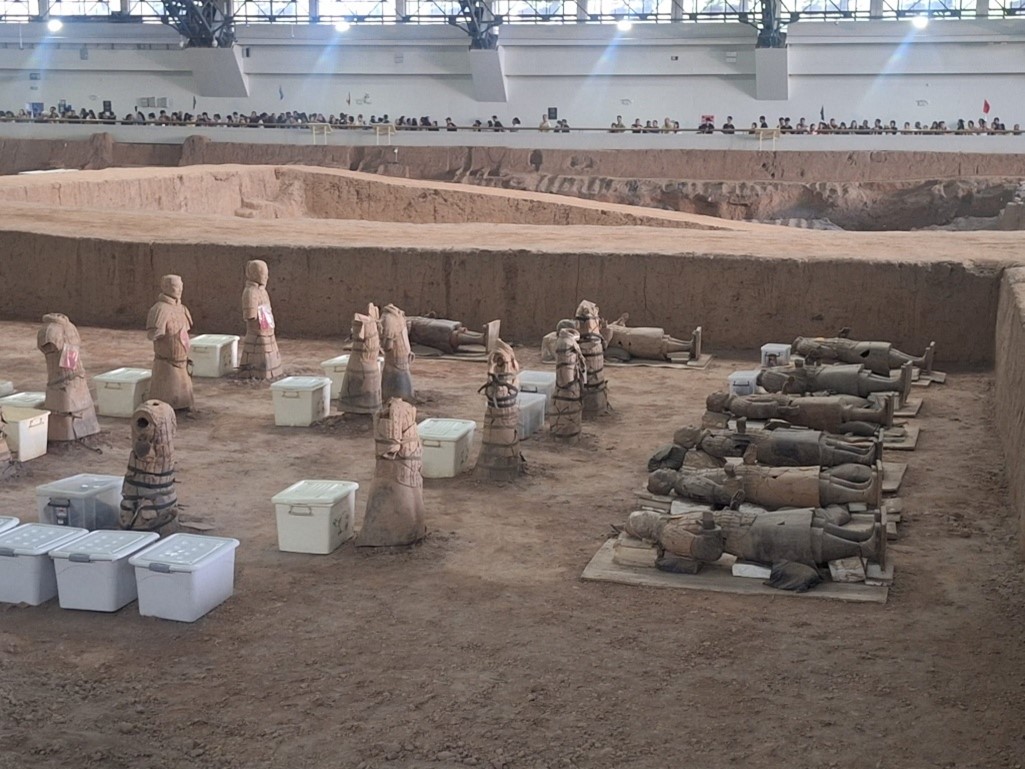
Hospital in Pit 1, and part of Pit 2 – Terracotta Army
We did not feel completely done with seeing walls by this point, so decided to cycle Xi’an’s historic city wall. The city wall is the most complete in China, being built in the 1370s, and is quite long, spanning around 8.5 miles. Today it has 18 gates, though most of these were added later to improve the modern flow of traffic; originally it only had four – north, south, east and west. Enclosed within the walls is the “historic city”, and outside, the more modern high rise buildings can be found. One of my favourite facts about Xi’an’s wall was that one of the building materials used to make it was sticky rice! We started at the south (Yongningmen) gate, and hired bikes; the only restriction for this is that you had to be over 12 years old and under 65. It was suggested that the cycle would take up to three hours, but we did it in under 2, with a few stops at scenic points and information boards. This was a wonderful and different way to experience heritage. Although I have been on many walking tours, I have not come across a self-led cycling tour like this before. We were able explore the wall at our own pace, following its cobbled pathways, and looking out onto the surrounding moat. The crenels and parapets lined the sides of the wall, and watchtowers could be found at each corner. I found it particularly interesting that many locals used these beautiful watchtowers as scenic backdrops for photoshoots, dressed in traditional clothes, and we had to avoid these shoots while passing the towers on our bikes!
Our final stop was at Xi’an’s Bell Tower, which was originally built in 1384 as a symbol of the city. We visited at night, which was great because the tower was mostly empty, and lit up with lights. From the top of the Bell Tower you can see the four main streets of Xi’an, as well as the nearby Drum Tower. Today, this grand structure sits at the centre of a huge, multi lane roundabout which was incredibly busy with cars, cyclists, tuktuks and pedestrians. To see the blend of historic and modern in such a stark way was a little bit magical, and a great way to end my time in China.
This was a beautiful trip, one that truly extended my understanding of architecture, art and culture. The sheer size of China and that of many of the cultural landmarks that I visited seemed to out scale anything that I have seen in England (though I have not visited Hadrian’s Wall yet). I feel like I saw many different variations of China’s cultural heritage, ranging from the natural beauty surrounding the Great Wall to the imperial architecture of the Forbidden City. It was important to see these emblems of national identity, and I believe they gave me a good insight into Chinese culture, in just a short few weeks. Alongside the built heritage which my trip focused on, we also visited a number of museums and galleries along the way, which further exemplified the local and national culture. I don’t think I could capture, in this short blog, all of the amazing things we experienced in China; the people were so friendly, with children regularly wanting to make conversation with us despite the language barrier, the food was very varied, with us often picking up a bowl of noodles for just a couple of British pounds, and the mountainous landscape outside of the cities was spectacular, I wish we could have spent more time there. All in all, I would recommend a trip to China wholeheartedly. Particularly special to me are the sketches I completed at each location; my small art inspired by those much larger monuments.
All photos by Victoria Sands and Christopher Jarvis